
Comparison of Classification Models for Predicting Admission Outcomes of Prospective Students with Disabilities
##plugins.themes.bootstrap3.article.sidebar##
##plugins.themes.bootstrap3.article.main##
Abstract
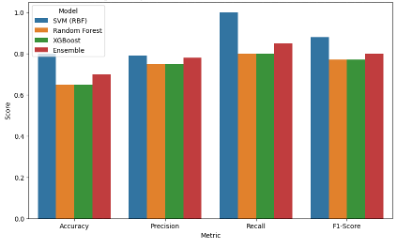
Students with disabilities are a group that requires special attention in the admission process at universities, especially at State Islamic Higher Education Institutions (PTKIN). Although inclusive policies have been implemented, challenges in implementation in the field are still quite significant, especially in terms of equal access and the readiness of educational institutions. This study aims to analyze the opportunities and challenges of accepting students with disabilities at PTKIN through a machine learning approach to predict the factors that influence selection graduation. The research data consists of 80 prospective students with disabilities who participated in the PTKIN selection, covering variables such as gender, province of origin, previous education, school accreditation, and type of disability. The research process included data cleaning, feature engineering (including categorical encoding and recategorization of disability variables), and data balancing using the SMOTE method. Next, model training was carried out using three main algorithms, namely Support Vector Machine (SVM), Random Forest, and XGBoost, as well as model combination (ensemble voting classifier) for performance comparison. The results show that the SVM (RBF kernel) model provides the best performance with an accuracy of 80% and an F1-score of 0.88 for the “Pass” class. This model outperforms Random Forest and XGBoost, which have an accuracy of 65% each. The most influential factors for graduation are the province of origin, disability category, and previous form of education. These findings indicate that the acceptance of students with disabilities at PTKIN is still influenced by geographical factors and educational background, so affirmative policies need to be directed at expanding access for people with disabilities from certain regions and backgrounds. The machine learning approach has proven to be effective as a tool for analyzing inclusive education policies in the PTKIN environment.
##plugins.themes.bootstrap3.article.details##

This work is licensed under a Creative Commons Attribution-ShareAlike 4.0 International License.
Authors who publish articles in CoreID Journal agree to the following terms:
- Authors retain copyright of the article and grant the journal right of first publication with the work simultaneously licensed under a CC-BY-SA or The Creative Commons Attribution–ShareAlike License.
- Authors are able to enter into separate, additional contractual arrangements for the non-exclusive distribution of the journal's published version of the work (e.g., post it to an institutional repository or publish it in a book), with an acknowledgment of its initial publication in this journal.
- Authors are permitted and encouraged to post their work online (e.g., in institutional repositories or on their website) prior to and during the submission process, as it can lead to productive exchanges, as well as earlier and greater citation of published work (See The Effect of Open Access).
References
N. Karki, A. Anwar, I. Ur Rehman, L. Husamaldin, and P. Saadati, “Smart Attendance Monitoring System Using Face Recognition for People with Disabilities (PwDs),” Proceedings of 2023 IEEE International Smart Cities Conference, ISC2 2023, 2023, doi: 10.1109/ISC257844.2023.10293664.
A. Anwar, I. Ur Rehman, Ijaz-Ul-Haq, and L. Husamaldin, “Smart Education for People with Disabilities (PwDs): Conceptual Framework for PwDs Emotions Classification from Student Utterances (SUs) during Online Learning,” ISC2 2022 - 8th IEEE International Smart Cities Conference, 2022, doi: 10.1109/ISC255366.2022.9922083.
M. Q. Huda, N. A. Hidayah, E. Khudzaeva, A. B. Lubis, Zulkifli, and I. Sujoko, “IT Adoption and Implementation on Pre-Implementation Phase: The Case of State Islamic University in Indonesia,” 2021 9th International Conference on Cyber and IT Service Management, CITSM 2021, 2021, doi: 10.1109/CITSM52892.2021.9587926.
R. Findiana, E. M. Yuniarno, and Endroyono, “Classification of Graduates Student on Entrance Selection Public Higher Education through Report Card Grade Path Using Support Vector Machine Method,” 2020 3rd International Conference on Information and Communications Technology, ICOIACT 2020, pp. 7–11, Nov. 2020, doi: 10.1109/ICOIACT50329.2020.9332072.
E. Khudzaeva, N. A. Hidayah, and Q. Aini, “Evaluation Model The Successful Use of Information Technology in Distance Learning at State Islamic Universities (PTKIN),” 2023 11th International Conference on Cyber and IT Service Management, CITSM 2023, 2023, doi: 10.1109/CITSM60085.2023.10455535.
E. N. Muratov et al., “When machine learning models learn chemistry II: applying WISP to real-world examples,” Digital Discovery, vol. 5, no. 2, pp. 583–591, Jan. 2026, doi: 10.1039/d0cs00098a.
K. Janssen, J. M. Wollschläger, J. Proppe, and A. H. Göller, “When machine learning models learn chemistry I: quantifying explainability with matched molecular pairs,” Digital Discovery, vol. 5, no. 2, pp. 571–582, Jan. 2026, doi: 10.1039/D5DD00398A.
A. E. J. Bulstra et al., “A Machine Learning Algorithm to Estimate the Probability of a True Scaphoid Fracture After Wrist Trauma,” J. Hand Surg. Am., vol. 50, no. 6, pp. 711–720, Jun. 2025, doi: 10.1016/j.jhsa.2025.01.021.
D. R. Ramdania, C. Slamet, H. F. Lutfiyah, M. Irfan, W. B. Zulfikar, and M. Harika, “Classification and Regression Trees (CART) Method in the Classification Process of Blood Control Candidates,” Proceeding of 2023 9th International Conference on Wireless and Telematics, ICWT 2023, 2023, doi: 10.1109/ICWT58823.2023.10335325.
W. B. Zulfikar, Angelyna, M. Irfan, A. R. Atmadja, and Jumadi, “A Deep Learning Approach Using VGG16 to Classify Beef and Pork Images,” JOIV : International Journal on Informatics Visualization, vol. 9, no. 2, pp. 568–574, Mar. 2025, doi: 10.62527/joiv.9.2.2848.
W. Wang, W. Xu, X. Yao, and H. Wang, “Application of Data-driven Method for Automatic Machine Learning in Economic Research,” Proceedings - 2022 21st International Symposium on Distributed Computing and Applications for Business Engineering and Science, DCABES 2022, pp. 42–45, 2022, doi: 10.1109/DCABES57229.2022.00019.
R. Pandiarajan, J. Jagannathan, P. S. Ramesh, A. Ponmalar, and Sudha, “Advanced Machine Learning Algorithms for 1Predictive Analytics in Healthcare to Enhance Patient Outcomes with Data-Driven Insights,” IEEE International Conference on Recent Advances in Science and Engineering Technology, ICRASET 2024, 2024, doi: 10.1109/ICRASET63057.2024.10895597.
P. Yesankar, C. Puri, A. Barahate, P. M. Gote, J. Hajbe, and A. Pawar, “Machine Learning in Healthcare: A Review of Current Applications and Future Trends,” 2nd International Conference on Machine Learning and Autonomous Systems, ICMLAS 2025 - Proceedings, pp. 482–487, 2025, doi: 10.1109/ICMLAS64557.2025.10968281.
R. Pandiarajan, J. Jagannathan, P. S. Ramesh, A. Ponmalar, and Sudha, “Advanced Machine Learning Algorithms for 1Predictive Analytics in Healthcare to Enhance Patient Outcomes with Data-Driven Insights,” IEEE International Conference on Recent Advances in Science and Engineering Technology, ICRASET 2024, 2024, doi: 10.1109/ICRASET63057.2024.10895597.
K. K. Hiran, D. Khazanchi, A. K. Vyas, and S. Padmanaban, “Machine learning for sustainable development,” Machine Learning for Sustainable Development, pp. 1–201, Jul. 2021, doi: 10.1515/9783110702514.
Y. Liang, J. Wang, and J. Wang, “Reconstructing Higher Education in the Big Data and AI Era: Interdisciplinary Integration and Problem-Driven Talent Cultivation,” 2025 10th International Conference on Distance Education and Learning, ICDEL 2025, pp. 47–51, 2025, doi: 10.1109/ICDEL65868.2025.11193480.
Y. Huang, “FS-SMOTE: An Improved SMOTE Method Based on Feature Space Scoring Mechanism for Solving Class-Imbalanced Problems,” IEEE Access, vol. 13, pp. 148074–148082, 2025, doi: 10.1109/ACCESS.2025.3597794.
H. Insan, S. S. Prasetiyowati, and Y. Sibaroni, “SMOTE-LOF and Borderline-SMOTE Performance to Overcome Imbalanced Data and Outliers on Classification,” 2023 3rd International Conference on Intelligent Cybernetics Technology and Applications, ICICyTA 2023, pp. 136–141, 2023, doi: 10.1109/ICICyTA60173.2023.10428902.
D. Chaerul Ekty Saputra, K. Sunat, and T. Ratnaningsih, “SMOTE-MRS: A Novel SMOTE-Multiresolution Sampling Technique for Imbalanced Distribution to Improve Prediction of Anemia,” IEEE Access, vol. 12, pp. 154675–154699, 2024, doi: 10.1109/ACCESS.2024.3482968.
A. Ahmad et al., “Vehicle Recognition using Multi-Layer Perceptron and SMOTE Technique,” Proceedings - 2022 2nd International Conference of Smart Systems and Emerging Technologies, SMARTTECH 2022, pp. 190–193, 2022, doi: 10.1109/SMARTTECH54121.2022.00049.
P. Lin, “Study on Real-Time Gesture Recognition Using Convolutional Neural Network Based on SMOTE Method,” 2024 6th International Conference on Applied Machine Learning (ICAML), pp. 53–58, Jul. 2024, doi: 10.1109/ICAML64299.2024.00020.
L. Wei, “Genetic Algorithm Optimization of Concrete Frame Structure Based on Improved Random Forest,” Proceedings - 2023 International Conference on Electronics and Devices, Computational Science, ICEDCS 2023, pp. 249–253, 2023, doi: 10.1109/ICEDCS60513.2023.00051.
Y. Wang, L. Liu, Y. Zhao, and X. Zhao, “Forest Resource Conservation Strategy with the Introduction of Random Forest Model Supported by Digital Technology,” 2024 6th International Conference on Applied Machine Learning (ICAML), pp. 274–279, Jul. 2024, doi: 10.1109/ICAML64299.2024.00056.
W. Martins, L. B. Bagesteiro, T. O. Weber, and A. Balbinot, “FPGA-based Implementation of Random Forest Classifier for sEMG Signal Classification,” Proceedings of the Annual International Conference of the IEEE Engineering in Medicine and Biology Society, EMBS, 2024, doi: 10.1109/EMBC53108.2024.10781521.
M. Irfan, W. B. Zulfikar, R. A. Ramadanti, A. Wahana, and Y. A. Gerhana, “Machine learning approach for scholarship candidate selection on Islamic State University in Indonesia,” AIP Conf. Proc., vol. 2646, no. 1, Apr. 2023, doi: 10.1063/5.0130047.
I. Lindra, Hendrawan, and A. Subekti, “A Systematic Review Network Slicing: Revenue Optimization for Slice Admission Control Objectives,” Proceeding of 2024 the 10th International Conference on Wireless and Telematics, ICWT 2024, 2024, doi: 10.1109/ICWT62080.2024.10674734.
D. A. Navastara, Y. Millaturrosyidah, T. P. Ramadhany, N. Suciati, C. Fatichah, and W. Suadi, “CTAB-GAN and Ensemble Learning for Predicting Student Admission in National Selection Based on Achievement,” 2025 15th International Conference on Information & Communication Technology and System (ICTS), pp. 1–6, Nov. 2025, doi: 10.1109/ICTS67612.2025.11369638.
S. Sujana, A. N. Kumar, L. Aditya Sree Charan, and G. Nishitha, “Comparative Analysis of Graduate Admission Predication using Neural Network,” 2024 Asia Pacific Conference on Innovation in Technology, APCIT 2024, 2024, doi: 10.1109/APCIT62007.2024.10673490.
Y. Zhang, Y. Zhao, M. Liu, and D. Yang, “Analysis and Prediction of Abnormal Behavior of higher Vocational Students Based on XGBoost Model,” 2025 8th International Conference on Advanced Algorithms and Control Engineering, ICAACE 2025, pp. 1900–1904, 2025, doi: 10.1109/ICAACE65325.2025.11019167.
S. Jeganathan, S. Parthasarathy, A. R. Lakshminarayanan, P. M. Ashok Kumar, and M. K. A. Khan, “Predicting the post graduate admissions using classification techniques,” 2021 International Conference on Emerging Smart Computing and Informatics, ESCI 2021, pp. 346–350, Mar. 2021, doi: 10.1109/ESCI50559.2021.9396815.
S. Nalam, M. Aleemuddin, Y. T. Kadari, and M. Nanda Kumar, “Advanced Graduate Admission Prediction,” 2023 IEEE 8th International Conference for Convergence in Technology, I2CT 2023, 2023, doi: 10.1109/I2CT57861.2023.10126307.